Hepatoblastoma (HB) is the most common pediatric liver cancer and one of the fastest growing types of cancer in children under 5 years of age. Although the current clinical treatment of HB (combining surgery and chemotherapy) has greatly improved patient outcomes, clinical options for treating HB are still limited.
On September 4, 2022, Tang Yujie and Xia Qiang from Shanghai Jiao Tong University co-authored a research paper titled "Single-cell Tranomics Uncovers Cellular Architecture and Developmental Trajectories in Hepatoblastoma" in Hepatology. The study established a single-cell transcriptome landscape of early human liver parenchymal development to explore the cellular roots and hierarchical structure of HB tumorigenesis.
The study further revealed that the HB tumor cell hierarchy not only coincides with the classic cancer stem cell model, but also reflects early human liver parenchymal development. This study establishes a framework for the development of future targeted diagnostics and therapeutics.
Hepatoblastoma (HB) usually occurs in children younger than 3 years old, suggesting that it may originate from liver progenitor cells in prenatal or very early postnatal liver tissue. Genomic analysis of tumor tissues has shown that HB has a simple genome with little replication copy number alternation or genetic mutation burden. Although currently used clinical treatments for HB (combining surgery and chemotherapy) have greatly improved patient outcomes, clinical options for treating HB remain limited. Therefore, it is critical to comprehensively evaluate the tumor biology of HB heterogeneity and establish consensus on molecular subtypes.
Single-cell RNA sequencing (scRNA-seq) is a powerful method to resolve cellular architecture and characterize cell identity. Based on the transcriptional trajectory and cellular heterogeneity of tumorigenesis, single-cell sequencing has been used to identify potential developmental cells in a variety of pediatric malignancies, including pediatric brain tumors, neuroblastomas, and Wilms' tumors.
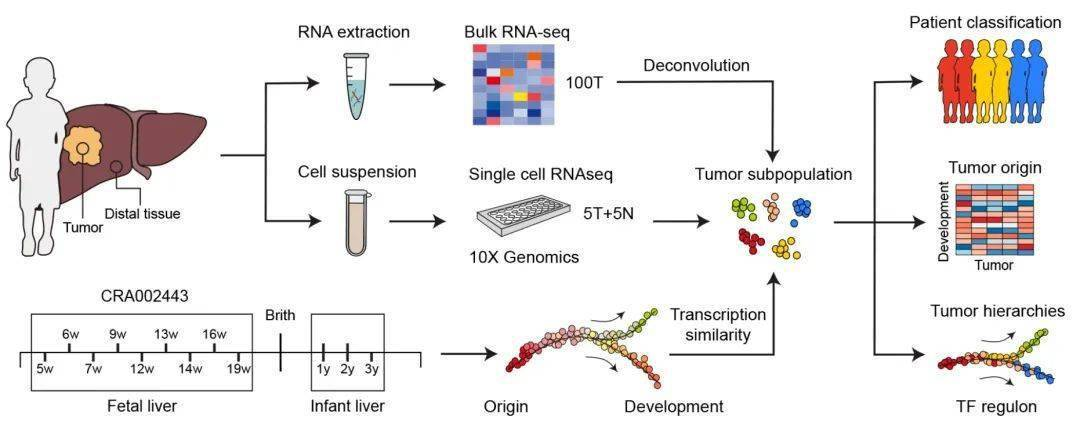
This study performed single-cell transcriptome analysis on tumor and distal liver tissue samples from five HB patients, and used deconvolution analysis to combine the transcriptome prohttps://www.renji.com/files of single cells with the transcriptome of the HB cohort after neuroadjuvant chemotherapy. A single-cell transcriptome landscape of early human liver parenchymal development was established to explore the cellular roots and hierarchy of HB tumorigenesis.
The researchers annotated seven different tumor cell subpopulations and established an effective HB subtyping method based on their composition. It was further revealed that the HB tumor cell hierarchy not only coincides with the classic cancer stem cell (CSC) model, but also reflects early human liver parenchymal development.
This study demonstrated a new HB subtyping method based on the composition of tumor cell subpopulations and proposed facilitating chromatin transcription (facilitates Chromatin Tranion, Inhibition of FACT may disrupt the oncogenic positive feedback loop between MYC and SSRP1 in HB, serving as a promising epigenetically targeted therapeutic strategy to target the CSC-like HB1-PRO subpopulation and its HB-associated high-risk "Pro-Like1" subtype.