"Being able to safely give birth to my baby—I really have to thank the doctors at Renji Hospital," said Ms. Zhou, 39, holding her one-year-old daughter Renxiao, her eyes glistening with tears. The name "Renxiao" carries a special meaning: "With Renji Hospital, there is joy." This baby, born amid the dual trials of a brain tumor and pregnancy, stands as a remarkable case in high-risk maternal care at Renji Hospital Affiliated to Shanghai Jiao Tong University School of Medicine.
Multidisciplinary Teamwork: Navigating Crisis Together
"Once an acoustic neuroma exceeds 3 centimeters in diameter, surgical difficulty and the risk of post-operative complications double. Beyond 4 centimeters, it can compress the brainstem and cerebellum, potentially endangering life," explained Dr. Zhang Xiaohua, Deputy Director of Neurosurgery and Director of the Craniocerebral Tumor Center at Renji Hospital.
In March 2024, Ms. Zhou, whose acoustic neuroma had grown to 4 centimeters, discovered she was 4 months pregnant during a check-up. Doctors warned that hormonal changes from pregnancy might accelerate tumor growth, increasing the risk of brainstem compression and posing an immediate threat to her life.
"The first hospital said I needed an immediate craniotomy, or both my life and the baby’s might be at risk," Ms. Zhou recalled. Faced with this heart-wrenching choice, she struggled: should she risk keeping the fetus or prioritize her own safety?
A turning point came in April 2024. Learning of Renji Hospital’s expertise in high-risk pregnancy care, Ms. Zhou reached out for help. Upon learning her situation, Renji’s obstetrics team decided to admit her, with Dr. Zhang Yu, Deputy Director of Obstetrics and Gynecology, promptly contacting Ms. Zhou.
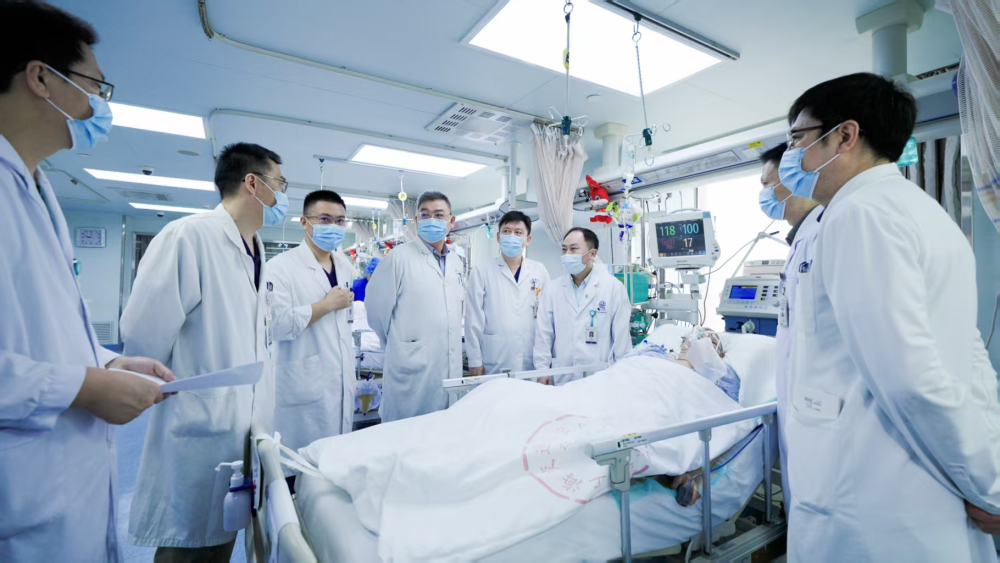
Chief Physician Zhang Xiaohua of the Department of Neurosurgery at Renji Hospital and others are making rounds of the wards.
This swift response stemmed from Renji Hospital’s robust multidisciplinary teamwork (MDT) system. As a national MDT demonstration unit accredited by the National Health Commission, Renji operates a specialized MDT clinic for pregnancy complicated with tumors and internal/surgical comorbidities, led by Chief Expert Dr. Di Wen, a senior obstetrician-gynecologist. For Ms. Zhou’s case, experts from obstetrics, neurosurgery, radiology, anesthesiology, and critical care held consultations, ultimately agreeing on a plan: continue the pregnancy with the tumor, deliver first, then perform surgery. Three contingency plans were prepared: for a smooth scheduled delivery, emergency situations, and extreme rescue scenarios. Throughout her pregnancy, Ms. Zhou underwent two MDT consultations, with precise plans for every step—from tumor growth monitoring to fetal development assessments.
Three Decades of Expertise: Supporting the High-Risk Case
The World Health Organization (WHO) defines critically ill pregnant women as those who experience life-threatening conditions from pregnancy to 42 days postpartum but survive. In 2006, Shanghai pioneered a five-color (green, yellow, orange, red, purple) risk grading system for pregnancy risk assessment, strengthening hierarchical maternal and infant care to enable early risk detection and warning. After over 30 years of development, Shanghai has built a mature management system for critically ill pregnant women, clearly defining life-threatening pregnancy complications and comorbidities.
"When Ms. Zhou came to me, she was classified as 'red' in the five-color warning system—high-risk, though not yet critically ill," Dr. Zhang Yu noted. Due to the tumor’s proximity to the brainstem, any progression could compress the vital center, pushing her into critical status. Thus, the hospital arranged biweekly follow-ups, with obstetric and neurosurgical experts staying in constant contact to address her questions during home rest.
On July 22, 2024, the day of delivery, Dr. Zhang Yu performed the cesarean section, while Dr. Zhang Xiaohua and his team stood by outside the operating room, "fearful of sudden increases in intracranial pressure after anesthesia." At 10:36 a.m., a cry filled the room—Renxiao was born, weighing 2,220 grams. Two months later, Ms. Zhou underwent a six-hour craniotomy led by neurosurgeons Dr. Jia Feng and Dr. Zhang Xiaohua. The tumor was nearly fully removed, with 70% of her facial nerve function preserved. "Her resting facial appearance is barely affected; she’s recovering well," Dr. Jia Feng observed when seeing her later. Ms. Zhou let out a sigh of relief.
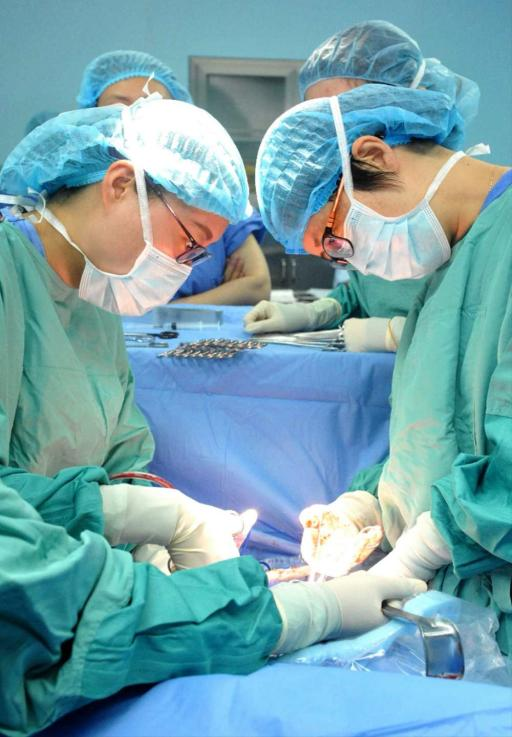
Chief Physician Zhang Yu of the Department of Obstetrics and Gynecology (first from the right) is performing a cesarean section.
At Renji Hospital, such high-risk rescue cases are not uncommon. In 1993, the hospital was designated as the "Shanghai Obstetric Heart Disease Monitoring Center". In 2007, it became one of the first municipal-level consultation and rescue centers for critically ill pregnant women. In 2015, Shanghai's first obstetric intensive care unit was established here. In 2024, it was selected as the Shanghai Training Center for Practical Skills in the Rescue of Critically Ill Pregnant Women for medical staff. Currently, Renji Hospital undertakes a large number of consultations, referrals, and rescue work for difficult and critically ill pregnant women in Shanghai and even the East China region. Every year, the number of critically ill pregnant women rescued accounts for 20% of the city's total. By 2024, it has accumulated over 2,000 cases of rescuing critically ill pregnant women, ranking first in the city in terms of total quantity, with a rescue success rate maintained above 97%.
Personalized Care: Honoring Patient Wishes
"Neurosurgery is the 'crown' of surgery, and skull base surgery is the 'jewel in that crown,'" Dr. Zhang Xiaohua noted. Ms. Zhou’s tumor, near the brainstem, required microsurgical precision with neurostimulation tools to locate the facial nerve—balancing complete tumor removal with maximal nerve preservation, a highly challenging feat.
Beyond technical skill, the team’s "people-centered" philosophy shone through. "We must grasp the overall patterns of disease while valuing each patient’s individual differences," Dr. Zhang emphasized. While similar diseases follow general treatment principles, individual variations in symptoms, physical constitution, and treatment responses demand personalized care—a true test of a team’s expertise and empathy.
Dr. Zhang’s original plan proposed craniotomy two weeks after the cesarean section. However, respecting Ms. Zhou’s wish to extend breastfeeding, the team reassessed and adjusted the timeline, monitoring closely until she was physically ready post-lactation.
"Treatment must be scientific, but patient wishes matter too. When risks are controllable, we wanted to help her fulfill her dream of motherhood," Dr. Zhang said. To safeguard high-risk maternal care, Renji Hospital has established real-time case discussion mechanisms with multidisciplinary experts, enabling instant information sharing via dedicated groups. The Obstetric Safety Office coordinates hospital resources, ensuring timely access to blood products, special medications, and other critical supplies.
As the only designated training center for the rescue of critically ill pregnant women in Shanghai, Renji hospital sends a large number of professional talents to primary medical institutions every year, continuously improving the regional capacity for rescuing critically ill pregnant women and extending the "lifeline of defense" to broader fields.
A Grateful Reunion: Where "Benevolence" Meets “Joy”
Shortly before Renxiao’s first birthday, Ms. Zhou returned to Renji Hospital with her daughter and mother to express gratitude. Holding Renxiao, she and her mother presented flowers and a silk banner to Drs. Zhang Xiaohua, Zhang Yu, and Jia Feng. The medical team inquired about Ms. Zhou's recovery with concern. When their eyes fell on the healthy and lively Renxiao, smiles of relief lit up both the doctors’ and the family’s faces.
This life-spanning guardianship—rooted in "ren" (benevolence)—ultimately bloomed into "xiao" (joy), writing a heartwarming, hopeful ending to a once-perilous story.
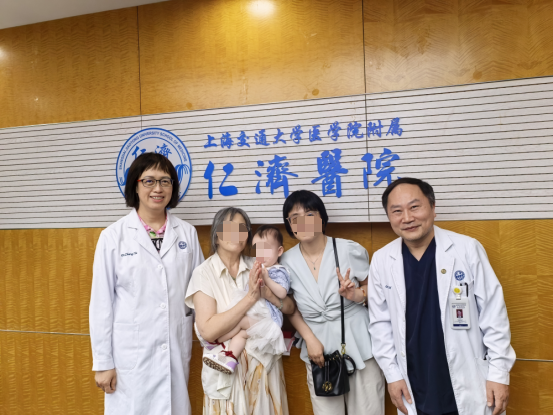
On July 22nd, Ms. Zhou returned to the hospital with her daughter and mother to express gratitude to the doctors.