A 16-year-old Chinese woman presented with a 7-year history of recurrent abdominal pain, haematemesis, melena and anaemia. Her previous oesophagogastroduodenoscopies (OGD) revealed nodular gastritis with discontinuous mucosal folds of the corpus. Gastric mucosa bleeding was described once and sclerosant injection together with titanium clip were performed. Biopsies were taken multiple times which indicated increase of eosinophils in lamina propria (up to 100/ HPF). She was diagnosed eosinophilic gastritis and treated with oral prednisolone. After weaning of prednisolone, the symptoms relapsed twice. She was allergic to both penicillin and cephalosporin antibiotics, having a history of urticaria and allergic rhinitis as well. Blood tests suggested mild iron-deficiency anaemia (haemoglobin 106g/L, Fe 5.1µmol/L, ferritin 5.6µg/L) and elevated IgE level (IgE 478.0 KU/L). Peripheral blood eosinophil count, autoimmune antibodies, tumour markers were all negative and there was no evidence for specific pathogen infection. OGD revealed smooth peninsula-shaped areas of the corpus with discontinuous mucosal folds. Multiple biopsies were taken again. There was no remarkable finding of capsule endoscopy and colonoscopy.
Biopsy specimens showed focal infiltrate of eosinophils in the lamina propria (>50/HPF at the antrum and >30/HPF at the corpus) . Several patchy-thickened subepithelial collagen depositions were observed at the corpus. A diagnosis of collagenous gastritis was made. It is a rare inflammatory condition with separate symptoms according to the age of onset. Our patient’s abdominal pain and upper gastrointestinal bleeding were in consistence with typical paediatric cases. Her pathological findings belonged to the eosinophil-rich pattern which could be easily confused with eosinophilic gastritis in regardless of representative clinical and endoscopic features. We prescribed oral iron supplement, proton pump inhibitors and topically targeted budesonide in an open-capsule formulation, starting from 3mg, three times a day with subsequent tapering and long-term maintaining. The patient has undergone monthly follow-up resulted in normal complete blood count after 1month’s therapy and acquired clinical remission for 7 months so far. This patient had a tortuous course from presentation to diagnosis. Close communication between physicians and pathologists is our key to recognise this case of collagenous gastritis in the disguise of eosinophilic gastritis. This case was published on Gut(https://gut.bmj.com/content/74/3/386.long).
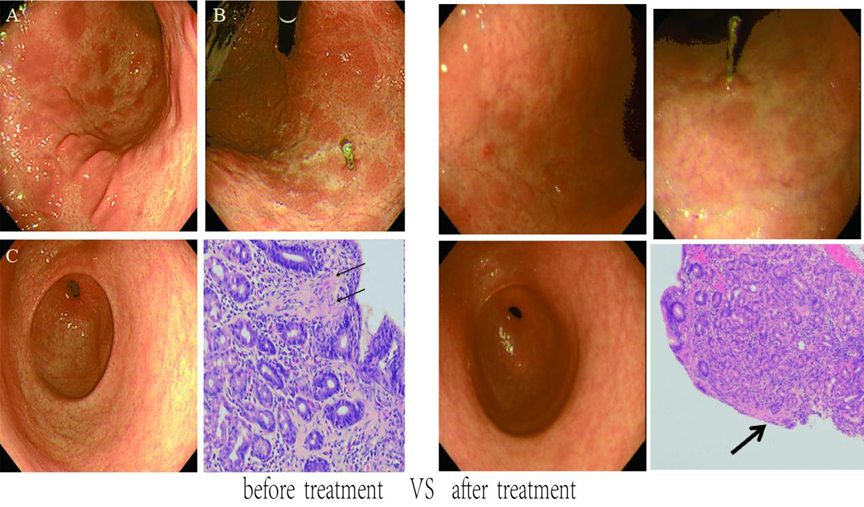
Figure 1 B efore and after treatment of Endoscopic images of smooth peninsula-shaped areas of the corpus with discontinuous mucosal folds (A&B), Normal antrum (C) and H&E staining of the biopsy at the corpus (patchy-thickened subepithelial collagen depositions arrow).