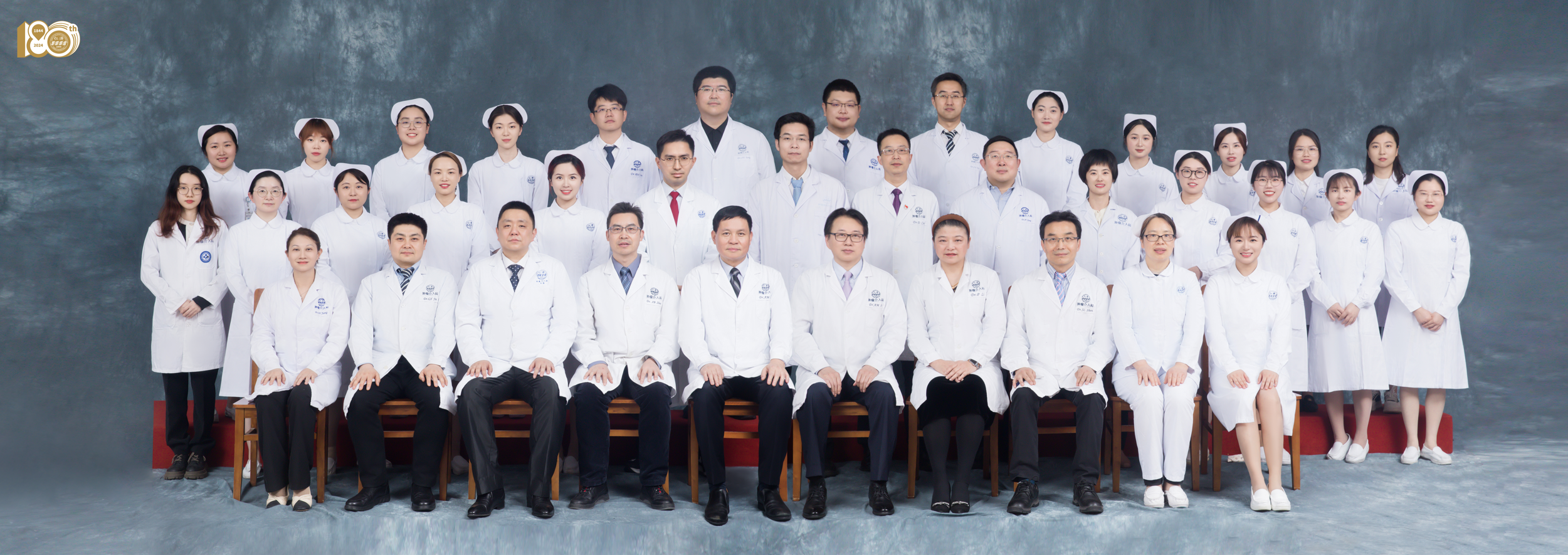
The history and overview
Established in August 2013, the Department of Interventional Oncology at Renji Hospital, School of Medicine, Shanghai Jiaotong University, is one of China's pioneering professional departments specializing in tumor interventional therapy. Recognized for its excellence, in 2019, it was designated as one of the Tumor Ablation Treatment Technology Training Bases by the Chinese Medical Association. The department spans two wards across the East and South campuses, offering a total of 75 beds, with 50 beds at the East campus and 25 at the South campus. The department’s staff includes 18 doctors: 4 chief physicians, 5 deputy chief physicians, 7 attending physicians, and 2 resident physicians. Additionally, the department employs 3 full-time scientific research and logistics personnel, including a PhD holder in bioinformatics. The department is also notable for its academic leadership, with four master's supervisors. Over 60% of its physicians hold a medical doctoral degree, underscoring the department's commitment to advanced medical education and research.
Focused on clinical treatment technology, the Department of Interventional Oncology places significant emphasis on developing specialized sub-disciplines. It operates under a professor responsibility system tailored to specific disease types and treatment technologies. Additionally, the department is dedicated to translational and clinical research, solidifying its reputation as a research-oriented specialized department for tumor intervention therapy.
A decade of unwavering commitment has culminated in the establishment of a robust clinical and scientific research system within the department. In the past three years, an average of 7129 cancer patients were discharged annually, and 11726 tumor intervention surgeries and procedures were completed annually, including 7620 third level or above interventional surgeries such as local tumor ablation, vascular intervention, particle implantation, and stent implantation.
Clinical treatments
1. Local Ablation Therapy for Tumors
The department is equipped with a wide array of ablation instruments and comprehensive adjuvant treatment strategies, which primarily include:
- Ultrasound-guided local ablation for both benign and malignant tumors.
- CT-guided percutaneous puncture ablation, primarily for lung tumors, as well as select liver, bone, and other tumors.
- Open magnetic resonance-guided ablation or particle implantation.
- Laparoscopic-assisted local ablation for conditions such as liver cancer and renal cell carcinoma.
- Tumor ablation through an open abdominal approach or combined with surgical resection for the treatment of multiple liver tumors.
Local ablation procedures have been successfully performed for a variety of tumors, including:
- Primary and metastatic liver cancer, with a focus on large, multiple, and high-risk liver tumors.
- Benign tumors such as hepatic hemangiomas and focal proliferative nodules.
- Thoracic tumors such as pulmonary ground glass opacity, early small lung cancer, and unresectable or unwilling middle and late-stage lung cancer.
- Benign tumors of the thyroid and breast, including thyroid tumors and breast fibromas.
- Intraperitoneal and retroperitoneal implant tumors.
- Metastatic tumors of bone and soft tissue.
- Lymph node metastasis in the hepatic hilum, retroperitoneum, and neck region.
- Kidney and adrenal tumors.
2. Tumor Vascular Embolization Chemotherapy Intervention Therapy:
The department has conducted numerous vascular intervention treatments for malignant tumors of solid organs such as the liver and lungs. These treatments include vascular embolization chemotherapy and continuous arterial infusion chemotherapy. Additionally, embolization surgeries have been performed for benign diseases, such as uterine fibroids, liver hemangiomas, and splenomegaly. Various emergency intervention surgeries under DSA, such as hemostasis, vascular occlusion after liver transplantation, and TIPS, have also been successfully carried out.
3. Radioactive Particle Implantation Therapy for Tumors (Close-Range or Internal Radiation Therapy).
Radioactive particle implantation therapy is a widely utilized and effective treatment modality for lung or liver tumors located in high-risk locations, as well as for portal vein tumor thrombi, bile duct thrombi, bone metastases, abdominal implant metastases, pelvic tumors, and more.
4. Implantation of Tumor Stents (Including Particle Stents) in the Lumens of Biliary, Esophagus, Gastrointestinal, and Airway Systems.
The implantation of tumor stents, including particle stents, within the lumens of the biliary, esophagus, gastrointestinal, and airway systems is a crucial intervention to alleviate obstruction and facilitate proper functioning.
5. Other Interventional Treatments or Procedures:
(1) Infusion Port Implantation.
(2) Vertebroplasty
(3) Tumor Puncture Biopsy.
(4) Various Puncture Drainage Techniques.
Research work
Over the past decade, the Department has embarked on and successfully completed numerous research projects,including over 40 initiatives sponsored by esteemed entities such as the National Natural Science Foundation of China, the Ministry of Science and Technology of China, the Shanghai Science and Technology Commission, and the Education Commission. Additionally, the department has led more than 10 fundamental or clinical translational research projects in collaboration with relevant laboratories and enterprises. Furthermore, it has actively participated in over 20 national multicenter clinical studies focusing on drugs and devices.
The department's doctors have made significant contributions to scientific literature, with a total of 143 papers published as first and/or corresponding authors in leading Chinese and English journals, including publications such as Nature, Science Translational Medicine, Cell Research, and Clinical Cancer Research. Notably, these publications include 87 SCI papers, with an impressive maximum Impact Factor (IF) score of 50.0. Furthermore, the department has authored 12 monographs in roles such as chief editor, deputy chief editor, or co-editor. Moreover, it has applied for 6 national utility model patents and 3 invention patents, underscoring its commitment to innovation and intellectual property.
In addition to its scholarly pursuits, the department has established robust clinical databases, follow-up databases, and tumor biological sample libraries, thus laying a solid foundation for future endeavors in both clinical and basic research.